
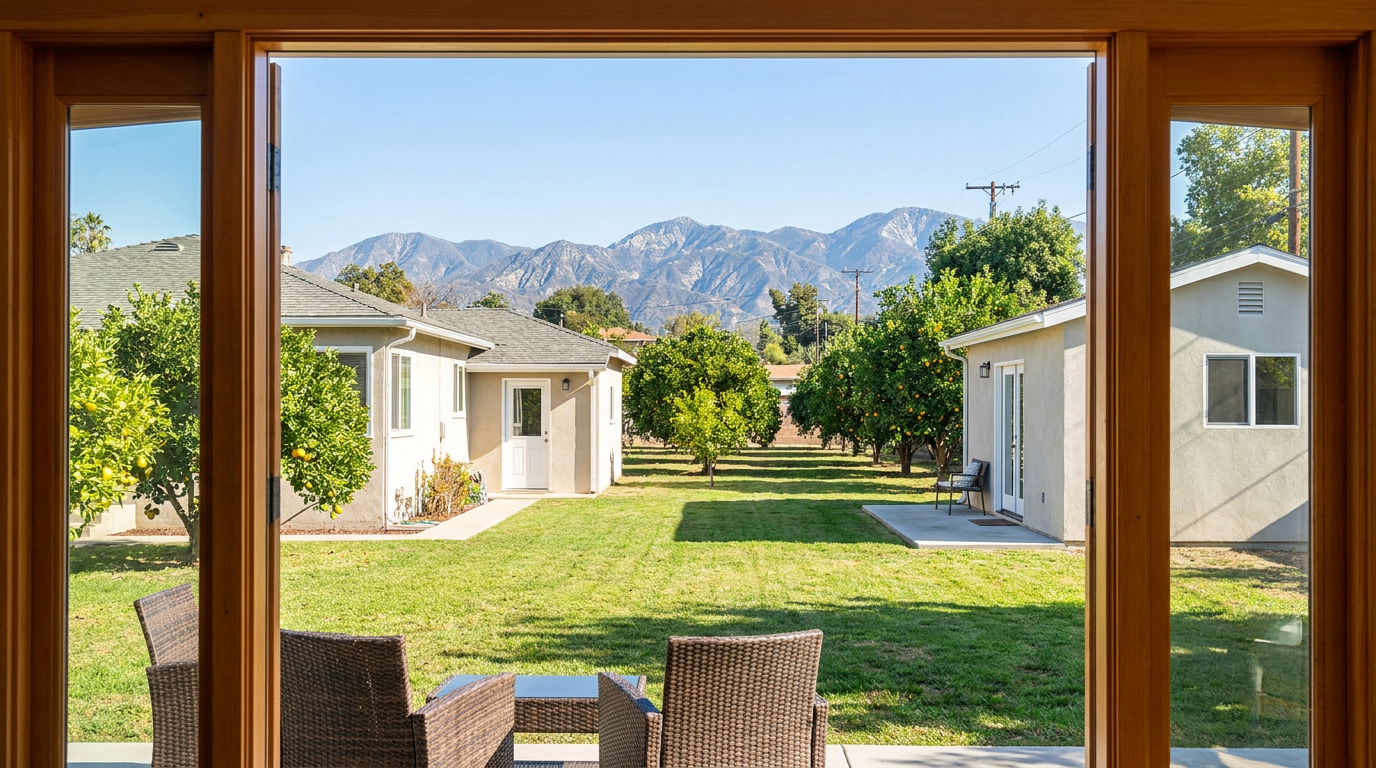
Evaluating the JADU vs ADU rental value in the San Gabriel Valley comes down to balancing gross monthly rental revenue against initial capital outlay. Across cities like Covina, West Covina, Glendora, and Pomona, a standard garage-conversion or detached Accessory Dwelling Unit (ADU) generates between $1,800 and $2,700 per month. In contrast, a Junior Accessory Dwelling Unit (JADU) typically commands $1,100 to $1,650 per month. While full ADUs generate roughly 40% to 60% more gross revenue, JADUs cost significantly less to construct, often producing a faster cash-on-cash payback period for local single-family property owners.
Understanding the Legal Definitions: ADU vs JADU in California
Before analyzing rental figures, SGV real estate investors must understand how California state law differentiates these two housing types under California Government Code Sections 65852.2 and 65852.22.
- Accessory Dwelling Unit (ADU): A complete, independent residential living unit located on the same lot as a single-family or multifamily home. ADUs can be detached structures, attached additions, or converted space (such as a standalone garage). They can measure up to 1,200 square feet, require a full kitchen (permanent cooktop, sink, refrigerator), and must include an independent bathroom. State law prohibits cities from enforcing owner-occupancy requirements on standard ADUs built between 2020 and 2025, with ongoing legislative extensions preserving investor flexibility.
- Junior Accessory Dwelling Unit (JADU): A smaller housing unit created entirely within the existing walls of a single-family home, attached garage, or existing accessory structure. JADUs are capped at 500 square feet and require an efficiency kitchen (sink, counter space, and 120-volt appliance connections). A JADU may include its own private bathroom or share sanitation facilities with the main residence. Crucially, under Cal. Gov. Code § 65852.22, JADUs require owner-occupancy in either the primary home or the JADU, unless the property is owned by a public agency, land trust, or housing organization.
San Gabriel Valley Rental Value Benchmarks
Rental rates across the San Gabriel Valley vary based on neighborhood sub-markets, proximity to major transit corridors, and nearby higher education institutions such as Cal Poly Pomona, Mt. San Antonio College (Mt. SAC), and Azusa Pacific University. Below are real-world market comparisons for newly finished units across key SGV cities.
1. Covina and West Covina
In Covina and West Covina, single-family neighborhoods situated near the I-10 and Highway 39 offer strong demand for small-footprint housing. A 350-square-foot studio JADU with a private entrance and dedicated bathroom rents for $1,250 to $1,450 per month, inclusive of utilities. A detached 1-bedroom, 600-square-foot ADU commands $1,900 to $2,250 per month, with tenants usually paying their own separately metered electricity and gas.
2. Glendora and San Dimas
Higher median home values in Glendora and San Dimas push rental yields upward. A high-end JADU built from a converted master suite or front-facing garage space rents for $1,350 to $1,600 per month. A newly built 2-bedroom detached ADU in Glendora frequently fetches $2,300 to $2,700 per month, appealing to young couples, healthcare workers from Emanate Health, and downsizing seniors.
3. Pomona and Azusa (College Corridors)
Properties near academic institutions experience high rental velocity for smaller, lower-cost units. In Pomona and Azusa, studio JADUs rent quickly at $1,150 to $1,400 per month. Standard 1-bedroom ADUs in these cities average $1,750 to $2,100 per month. The presence of student populations makes smaller JADUs particularly easy to lease during late summer months.
Construction Costs vs. Rental Income: The ROI Comparison
Gross rent tells only half the story. The true financial winner depends on capital expenditures, soft costs, and payback timelines.
JADU Cost and Return Profile
Because a JADU sits entirely inside the existing building footprint, homeowners avoid major foundation work, utility main upgrades, and heavy structural framing. Converting an attached garage bay or spare bedroom into a JADU in Covina typically costs between $35,000 and $75,000 depending on finish quality and plumbing location.
- Average Build Cost: $50,000
- Average Monthly Rent (SGV): $1,350
- Annual Gross Revenue: $16,200
- Estimated Simple Payback: 3.1 to 4.2 years
ADU Cost and Return Profile
Building a detached ADU or undertaking a full garage conversion to a standalone 1-bedroom ADU involves structural modifications, trenching for new utility lines, title 24 energy calculations, and higher city permit fees. Construction costs in the SGV range from $130,000 for a standard garage conversion to $250,000+ for a ground-up 2-bedroom detached unit.
- Average Build Cost (Detached 1-Bed): $180,000
- Average Monthly Rent (SGV): $2,150
- Annual Gross Revenue: $25,800
- Estimated Simple Payback: 7.0 to 8.5 years
While the standard ADU generates $9,600 more in gross annual income, the JADU delivers a significantly higher initial cash-on-cash yield due to its minimal upfront capital cost.
Tenant Profiles, Privacy, and Property Management Considerations
Managing a JADU is fundamentally different from managing an ADU. Because a JADU shares a physical structure with the main residence, soundproofing and screening take on heightened importance.
Sound Isolation and Utility Allocation
When constructing a JADU, installing resilient channels, quiet-rock drywall, and sound-dampening insulation (such as Rockwool R-15) in shared walls is non-negotiable. Additionally, JADUs rarely feature separate electrical submeters due to service panel constraints. Landlords must either include utilities in the flat rent rate or utilize a Ratio Utility Billing System (RUBS) to split costs fairly based on occupancy.
Tenant Placement and Lease Execution
JADU tenants are typically single occupants—grad students, traveling medical staff, or young professionals seeking an affordable alternative to large apartment complexes. Turnover on 300-square-foot units is naturally higher, averaging 12 to 18 months. ADUs attract longer-term occupants (24 to 36+ months) who stay longer due to full-sized kitchens and separate living spaces.
To safeguard your investment, professional screening and robust contract standards are essential. Working with an experienced firm for professional property management services ensures compliant applicant screening, proper security deposit handling under California Assembly Bill 12, and thorough Lease Execution that clearly establishes quiet hours, parking designations, and utility responsibilities.
SGV Municipal Permitting and Impact Fees
Local municipal rules play a major role in your project timeline and budget. Under California law, both ADUs and JADUs smaller than 750 square feet are exempt from municipal development impact fees. However, plan check fees and utility connection rules vary by city:
- City of Covina: Offers expedited ADU plan check tracks for pre-approved architectural plans, making garage conversions efficient.
- City of West Covina: Enforces strict setback requirements for two-story detached units, whereas single-story JADUs avoid exterior setback triggers entirely.
- Parking Regulations: Under AB 2097, cities cannot impose parking minimums on ADUs or JADUs located within one-half mile of public transit stops (including major bus corridors along Azusa Avenue, Grand Avenue, and Foothill Boulevard).
Which Option Fits Your Investment Strategy?
If your primary goal is maximizing cash-on-cash return with minimal debt service or liquid capital outlay, building a JADU inside your existing footprint is often the fastest path to positive cash flow. If your strategy focuses on long-term equity addition, maximum monthly gross income, and retaining the ability to rent out both units simultaneously without living on-site, a detached or full-conversion ADU is the superior long-term play.
Deciding how to optimize your single-family or multi-family parcel in Covina, Glendora, or Pomona requires careful local market analysis. If you want to evaluate potential rental yields or discuss professional oversight for your residential property, feel free to talk to our team today.
Disclaimer: Bright Path Property Management provides property management and real estate brokerage services. The information in this article is for educational purposes only and does not constitute legal, financial, architectural, or tax advice. California land use statutes and local municipal codes change frequently. Property owners should consult with qualified licensed attorneys, certified accountants, and local planning departments before starting construction.