
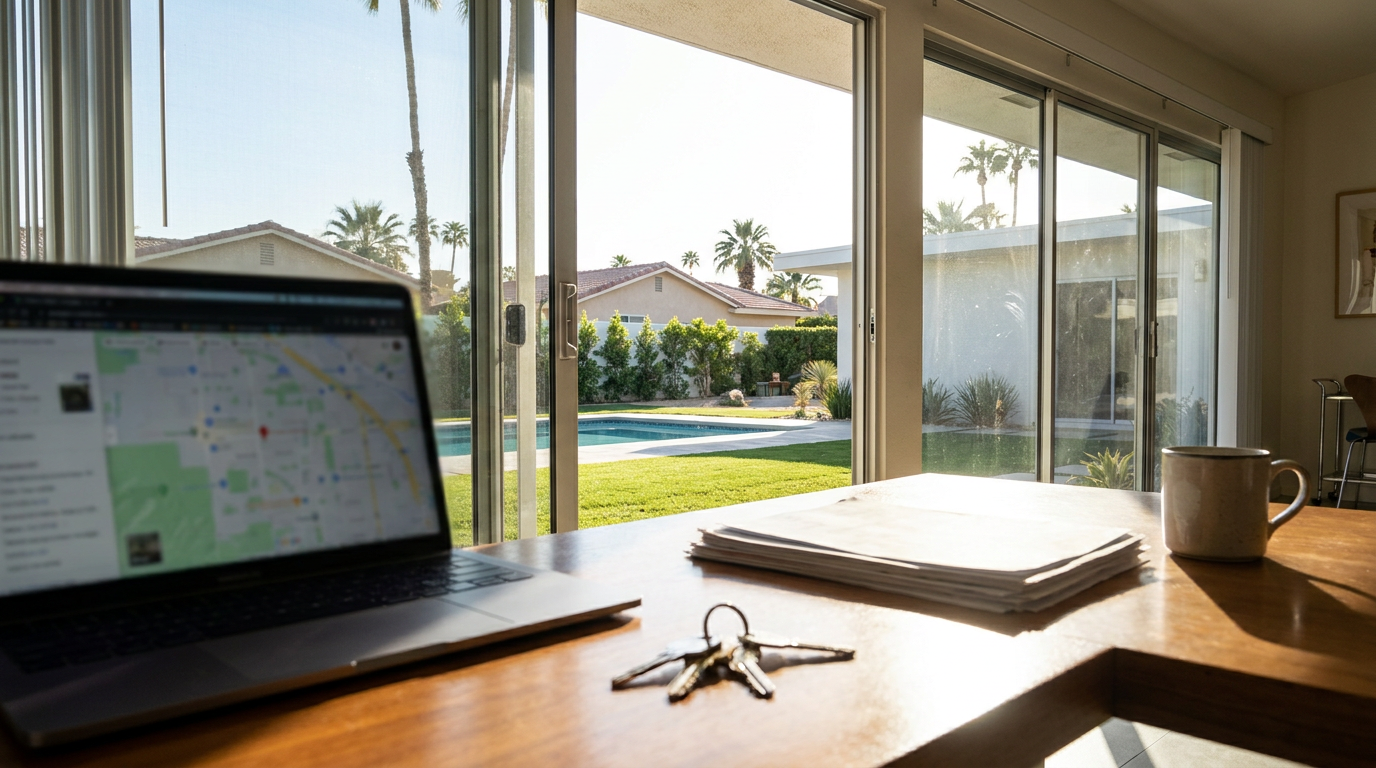
Deciding between palm springs long term rental management vs airbnb comes down to evaluating municipal cap restrictions, seasonal revenue swings, and ongoing operational overhead. While short-term rentals historically offered attractive peak-season daily rates, Palm Springs' strict vacation rental ordinances, 20% neighborhood permit caps, and Transient Occupancy Tax (TOT) compliance have shifted the financial equation. For many Coachella Valley property owners, traditional long-term leasing delivers higher net operational income with significantly reduced regulatory risk.
The Regulatory Reality: Palm Springs STR Rules vs. Long-Term Freedom
Palm Springs enforces some of the most stringent short-term rental (STR) regulations in Southern California under Municipal Code Chapter 5.56. Understanding these rules is essential before choosing a leasing strategy for your investment property.
- Neighborhood Permit Caps: Single-family residential zones in Palm Springs are subject to a strict 20% cap on STR permits per neighborhood overlay zone. In many desirable neighborhoods like Movie Colony, Vista Las Palmas, and Historic Tennis Club, permit waitlists can span years.
- Contract Limits: Permitted short-term rentals are restricted to executing a maximum of 36 guest contracts per calendar year (plus up to 4 additional contracts during off-peak summer months).
- Transient Occupancy Tax (TOT): STR operators must collect and remit an 11.5% TOT tax to the City of Palm Springs, along with monthly reporting requirements and mandatory registration fees exceeding $1,000 annually.
- Strict Enforcement: Outdoor music is strictly prohibited at short-term properties, and municipal code violations carry immediate fines starting at $5,000 for operating without a license.
By contrast, long-term rentals (leases executed for 30 consecutive days or longer) are completely exempt from Palm Springs STR permit caps, contract limits, TOT collection, and annual city vacation rental inspections. Landlords operating long-term properties retain their fundamental property rights without fear of sudden municipal code amendments.
Revenue Breakdown: Seasonal Spikes vs. Predictable Net Cash Flow
Comparing gross revenue figures for Airbnb properties against long-term rentals often leads to misleading conclusions. While a Palm Springs vacation rental might generate $8,000 in a single peak month like March, gross revenue does not reflect net yield.
The Impact of Coachella Valley Seasonality
The Coachella Valley real estate market experiences extreme climate-driven seasonality. From January through April, high demand driven by Modernism Week, the BNP Paribas Open, and the Coachella Valley Music and Arts Festival inflates nightly rates. However, from June through September, daytime temperatures regularly exceed 105°F, causing short-term occupancy rates across Palm Springs, Cathedral City, and Indio to plunge below 30%.
Expense Comparison Matrix
To calculate true net operating income, investors must account for the heavy expense load required to run a high-turnover Airbnb:
- Utilities: Short-term landlords pay 100% of utility bills. Running air conditioning continuously during desert summers can result in electric bills topping $600 to $1,000 per month. In a long-term rental, tenants typically assume responsibility for electricity, gas, and trash.
- Management Fees: Full-service vacation rental management companies in the desert charge between 18% and 30% of gross revenue. Professional property management services for long-term residential homes generally cost a predictable 7% to 10% of monthly rent.
- Turnover Costs & Supplies: Airbnb properties require professional linen laundering, deep cleaning between every stay ($150 to $300 per turnover), guest toiletries, pool maintenance, and regular replacement of damaged furniture. Long-term leases incur turnover costs only once every 12 to 24 months.
When factoring in summer vacancies, high utility bills, management commissions, and city registration fees, a long-term rental generating $3,500 per month often delivers equal or superior annualized net cash flow compared to an Airbnb generating $55,000 in gross annual revenue.
Operational Demand: Guest Hospitality vs. Asset Protection
Managing an Airbnb is fundamentally a hospitality business, whereas long-term rental management is real estate asset preservation.
Short-term rentals require round-the-clock availability. Owners must respond instantly to guest inquiries, handle late-night lockouts, replace broken appliances on short notice, maintain noise-monitoring systems like NoiseAware, and actively manage guest reviews to protect search rankings. Negative reviews can permanently depress booking performance.
Long-term leasing eliminates daily guest logistics. The focus shifts to thorough upfront tenant screening—evaluating credit profiles, verifying stable income, checking rental history, and executing compliant California lease agreements. Once a qualified tenant moves into your Palm Springs, La Quinta, or Rancho Cucamonga home, ongoing operational effort drops to routine rent collection and scheduled preventative maintenance.
California Landlord-Tenant Laws: AB 1482 Considerations
Investors transitioning from short-term rentals to traditional leasing must understand California housing laws, specifically the Tenant Protection Act of 2019 (AB 1482).
AB 1482 imposes state-level rent caps (5% plus local CPI, capped at 10% maximum per year) and requires just-cause eviction grounds for tenants who have occupied a property for more than 12 months. However, single-family homes and condominiums are explicitly exempt from AB 1482 rent control and just-cause restrictions, provided the property is not owned by a corporation or real estate investment trust (REIT) and the required statutory exemption notice is included in the written lease agreement.
Multi-family residential properties (such as duplexes or fourplexes in Pomona, Riverside, or Palm Springs) over 15 years old remain subject to AB 1482. Partnering with experienced professionals ensures lease execution fully complies with state disclosure mandates while protecting your long-term yield.
The 30-Day+ Medium-Term Hybrid Option
For investors who want to avoid Palm Springs STR permit caps while retaining flexibility, the 30-day+ seasonal or mid-term rental strategy provides an ideal middle ground. Renting to traveling medical professionals, remote workers, or winter snowbirds for stays of 30 to 90 days bypasses city vacation rental permits entirely, eliminates TOT tax obligations, and captures elevated seasonal rates without high guest turnover.
Choosing the Right Strategy for Your Property
If your property is located in an un-capped neighborhood, boasts unique luxury amenities, and you enjoy managing customer service, short-term renting may suit your goals. However, if your target neighborhood has reached its 20% permit limit, or if you prefer predictable, hands-off passive income without seasonal cash-flow spikes, long-term leasing is the superior strategy.
At Bright Path Property Management, led by Chris Formica, we help real estate investors across the San Gabriel Valley, Inland Empire, and Coachella Valley optimize their portfolio yields through professional leasing and tenant placement. If you are ready to evaluate your property's potential, talk to our team today at 800-325-6836.
Disclaimer: The information provided in this article is for educational and informational purposes only and does not constitute legal, tax, or financial advice. Housing laws and municipal short-term rental codes in Palm Springs and surrounding cities change frequently. Consult a qualified attorney or certified accountant regarding your specific legal or financial situation.