A California eviction (an unlawful detainer case) moves in five stages: a written notice, the court filing, service of the summons and complaint, a default or trial, and a sheriff lockout. Uncontested cases typically take 30 to 60 days, and contested cases can take longer. After personal service, the tenant has 10 days, not counting weekends and court holidays, to respond (Code of Civil Procedure 1167). Starting January 1, 2027, AB 747 (the SPARE Act) and AB 2042 tighten service: three good-faith personal attempts on three different days at three different times before substituted service or posting, a GPS and time stamped photo of each attempt, and a new motion that lets a tenant challenge a default for improper service, with the landlord bearing the burden to prove service was lawful.
Updated October 12, 2026
This is general information, not legal advice. Talk to a California eviction attorney about your specific case.
Skipping statutory steps or making procedural errors can reset the clock and extend your timeline. If rent is already late, start with handling late rent before an eviction.
Stage 1: Serving the Mandatory Written Notice (3 to 60 Days)
Before filing an eviction action in court, California Code of Civil Procedure requires landlords to serve the proper legal notice. The timeline begins the day after valid service is executed.
- 3-Day Notice to Pay Rent or Quit: Used for nonpayment of rent. Under California law, the 3-day countdown excludes weekends and judicial holidays. If rent remains unpaid after 3 full court days, you can proceed to file in court.
- 3-Day Notice to Perform Covenants or Quit: Used for curable lease violations, such as unauthorized pets or occupants. The tenant has 3 court days to correct the breach or surrender possession.
- 3-Day Notice to Quit (Non-Curable): Reserved for severe violations including illegal activity, nuisance, or severe property damage.
- 30-Day or 60-Day Notice to Vacate: Under the California Tenant Protection Act (AB 1482), if a tenant has occupied the property for more than 12 months, a 60-day notice with valid just-cause (at-fault or no-fault) is generally required, unless the property is exempt. For tenancies under 12 months, a 30-day notice applies.
See how to serve a 3-day notice, 30-day and 60-day notices, and just cause rules. Starting January 1, 2027, the eviction complaint must state the method used to serve the notice and the date, time, and location of service (Code of Civil Procedure 1166(a)(5), added by AB 747). Keep a written record of exactly when and where each notice was served.
Stage 2: Filing the Unlawful Detainer Complaint (1 to 5 Days)
If the tenant does not comply with the notice, your attorney or management representative files an Unlawful Detainer complaint in the local Superior Court courthouse, such as the court facilities in Pomona, West Covina, Rancho Cucamonga, or Riverside. Drafting, filing, and processing the paperwork with the court clerk usually takes 1 to 5 business days.
Stage 3: Service of Process and Tenant Response (10 to 20 Days)
Once filed, the Summons and Complaint must be served on the tenant. A summons may be served by any person who is at least 18 and not a party to the case (Code of Civil Procedure 414.10), so the landlord cannot serve it personally. Service methods affect the timeline:
- Personal Service: The tenant is handed the documents directly.
- Substituted Service or Order for Posting (Nail and Mail): Allowed only after personal delivery cannot be made with reasonable diligence. Substituted service (leaving the papers with a competent adult at the home and mailing a copy) and court-ordered posting (posting on the premises plus certified mail) are each deemed complete on the 10th day after mailing (CCP 415.20 and 415.45).
After service, California Code of Civil Procedure Section 1167 gives the tenant 10 court days (excluding Saturdays, Sundays, and judicial holidays) to file a formal written Answer or Motion (such as a Demurrer) with the court. Before January 1, 2025, it was 5 court days.
From January 1, 2027, these service steps get stricter. See the next section.
2027 change: stricter proof of service under AB 747 and AB 2042
Which laws, and when
- AB 747 (Kalra), the Service of Process Accountability, Reform and Equity (SPARE) Act: Chapter 563, Statutes of 2025, approved and filed October 10, 2025. Its service provisions are operative January 1, 2027.
- AB 2042 (Kalra): Chapter 379, Statutes of 2026, approved and filed September 20, 2026. A follow-up that amends two of AB 747's sections (CCP 417.10 and 473.2). It takes effect January 1, 2027.
Three attempts before substituted service or posting
Reasonable diligence now means attempting personal delivery of the summons and complaint, in good faith, on at least three occasions on three different days at three different times (CCP 415.20(b)(2) for substituted service and CCP 415.45(d)(1) for unlawful detainer posting). For a posting order, at least one attempt must be at the tenant's dwelling or usual place of abode if it is known or could be found with reasonable effort (CCP 415.45(d)(2)).
A time and GPS stamped photo of each attempt
- For personal service, substituted service, and posting, the proof of service must include one or more photos of the site of each effected or attempted service. Each photo needs a readable stamp that automatically records the date, time, and GPS (or equivalent) coordinates (CCP 417.10(a)(1)).
- At a home, at least one photo per attempt must show the door, or the entrance if the door is not reasonably accessible, with a specific explanation of why (CCP 417.10(a)(2)).
- If there is no GPS or cell signal, the server must explain why in a detailed statement. If taking a photo would compromise the server's safety, the server documents the attempt and explains why instead. Photos must be taken as close as practicable to the time of the attempt.
Tenants can challenge a default for improper service
- New CCP 473.2 lets a party who was not served according to the rules move to set aside or vacate a default or default judgment and for leave to defend, or for dismissal as permitted by law.
- The tenant must offer evidence, such as a sworn affidavit, that service was not lawfully made. That rebuts the presumption that the process server's return is true.
- The landlord then has the burden of proving, by a preponderance of the evidence, that service was lawful. The court must take evidence and may not deny a reasonable request for a hearing with oral testimony.
- AB 747 also adds to CCP 473 that a motion to vacate a default judgment that is void for lack of proper service may be brought at any time after the judgment.
What AB 2042 changed
- It clarifies that CCP 473.2 applies to service attempted or completed on or after January 1, 2027.
- It states that courts keep their existing authority to decide motions involving a proof of service filed before January 1, 2027.
- It keeps AB 747's rule that a return filed before the operative date is not unlawful or insufficient just because it lacks the new photo.
- It makes a small wording change to the photo rule (the safety statement can be on or with the proof of service).
Other AB 747 changes worth knowing
- The complaint must state the date, time, and location of service of the termination notice (CCP 1166(a)(5)).
- County registers of process servers become publicly available, and a registered server's proof of service must show their registration number (CCP 417.40).
What owners should do for evictions served on or after January 1, 2027
- Write down the date, time, and location every notice (3-day, 30-day, 60-day) is served. The 2027 complaint must state them.
- Work with an attorney and a registered process server who are ready for the 2027 rules: three attempts on different days and times, a time and GPS stamped photo of each attempt showing the door, and the required statements when a photo or signal is not possible.
- Ask to see the full proof of service, with photos, before relying on a default.
- Expect that a default can be challenged if service was not lawful, and that you will have to prove service.
- Do not serve the summons yourself. As a party to the case, the landlord cannot serve it (CCP 414.10).
Stage 4: Court Judgment or Trial Request (15 to 30 Days)
What happens next depends entirely on whether the tenant responds:
Scenario A: The Tenant Fails to Answer (Default Judgment)
If 10 court days pass without a tenant filing, you can file a Request for Entry of Default and Clerk Judgment for Possession. Obtaining a default judgment usually takes 5 to 15 business days depending on court processing speed. From 2027, a default can be challenged under CCP 473.2 if service was not done correctly, so the proof of service matters even when the tenant does not respond.
Scenario B: The Tenant Files an Answer (Contested Eviction)
If the tenant files an Answer, you must file a Request to Set Case for Trial. Under California law, the court must schedule the Unlawful Detainer trial within 20 calendar days of the written request. However, motions or discovery requests can extend this stage by several weeks.
Stage 5: Judgment, Writ of Possession, and Sheriff Lockout (10 to 20 Days)
Upon winning at trial or securing a default judgment, the court grants a Judgment for Possession. The process then enters its final stage:
- Issuance of Writ of Possession: The court clerk issues a Writ of Possession, which is forwarded to the County Sheriff Office (e.g., Los Angeles, San Bernardino, or Riverside County Sheriff).
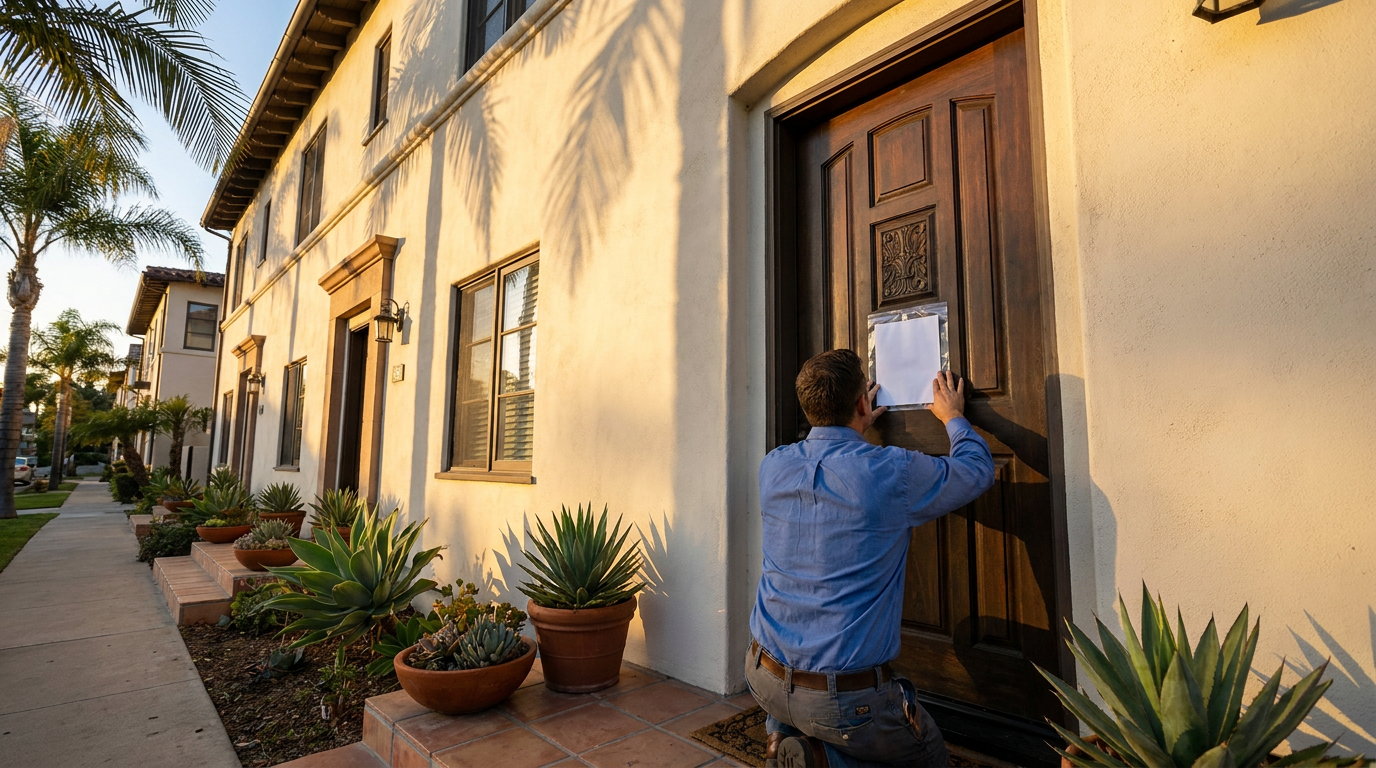
- Sheriff Posting: A sheriff deputy posts a physical 5-Day Notice to Vacate on the property door.
- Physical Lockout: If the tenant has not vacated by the end of the 5th day, the sheriff returns to perform a physical lockout and hand possession back to the property owner.
Local Factors Impacting Timelines in Southern California
Eviction timelines vary significantly across Southern California municipalities. In Los Angeles County, local tenant defense programs and court calendaring can lengthen contested cases beyond 90 days. In San Bernardino, Riverside, and the Inland Empire, court calendars may move slightly faster, but statutory notice requirements and mandatory local mediation programs must still be rigorously observed.
Streamlining Rental Operations with Professional Management
Navigating California property regulation requires precise compliance at every step. Even minor errors in notice drafting or service verification can cause a court to dismiss an Unlawful Detainer action, forcing owners to restart the legal timeline from day one. If you want to avoid court altogether, consider cash for keys as an alternative. Bright Path's Plus ($199/month) and Shield ($249/month) plans include landlord protection that lists $5,000 in eviction legal fees and $600 in sheriff/constable fees. Learn how our property management services can safeguard your investments, read our owner FAQ, or talk to our team to discuss your portfolio needs.
Sources
- AB 747 chaptered text (Chapter 563, Statutes of 2025)
- AB 747 history
- AB 2042 chaptered text (Chapter 379, Statutes of 2026)
- AB 2042 history
- Code of Civil Procedure 1167 (10-day response)
- Code of Civil Procedure 414.10 (who may serve a summons)
- Code of Civil Procedure 1170.5 (trial within 20 days of request)
The 2027 versions of CCP 415.20, 415.45, 417.10, 473, 473.2, and 1166 will not appear on the state's code pages until they are operative, so the bill text links are the best source for now.
This is general information, not legal advice. Talk to a California eviction attorney about your specific case.