
Serving a 3-day notice to pay rent or quit california template requirements document is the mandatory first legal step when a tenant falls behind on rent. Under California Code of Civil Procedure (CCP) § 1161(2), this formal notice demands that the tenant either pay the full past-due rent balance or surrender possession of the rental unit within three business days. Because California courts enforce technical compliance with extreme strictness, even a minor mistake on your notice template—such as including late fees or failing to list specific payment window hours—can cause an Unlawful Detainer judge to dismiss your legal action entirely.
Mandatory Information Required on a California 3-Day Notice Template
To withstand judicial scrutiny in Los Angeles County, San Bernardino County, or Riverside County courts, your 3-day notice template must contain specific, unalterable statutory components. Omitting any of these required fields renders the notice legally defective under state law:
- Tenant Legal Names and Address: You must list every adult tenant named on the rental agreement, along with all unknown occupants ('and All Other Occupants in Possession'). The full street address, unit number, city, and zip code must be clearly stated.
- Exact Amount of Past-Due Rent: The notice must state the precise dollar amount of unpaid rent due. You must breakdown the specific months or rental periods that the sum covers (for example, 'May 1, 2026 through May 31, 2026: $2,100.00').
- Explicit Demand for Payment or Vacate: The text must clearly state that the tenant has three days to either pay the full amount or move out and deliver possession back to the owner.
- Landlord or Agent Signature: The document must be signed and dated by the property owner or an authorized representative.
Strict Rules Regarding Rent vs. Non-Rent Fees
One of the most frequent errors Southern California self-managing landlords make when drafting a notice template is combining late charges, utility charges, or bounced check fees into the total amount demanded. Under California law, a 3-Day Notice to Pay Rent or Quit can only demand past-due base rent.
If your monthly lease execution states that rent is $2,400 per month and carries a $100 late fee, your 3-day notice amount line must state exactly $2,400. Demanding $2,500 on a notice to pay rent or quit invalidates the notice because you are legally demanding non-rent fees under threat of forfeiture. If a tenant contests the notice in court and demonstrates that the requested sum includes non-rent charges, the court will dismiss the eviction lawsuit, and you may be held liable for the tenant's attorney fees.
Required Payment Information Under CCP § 1161(2)
California Code of Civil Procedure § 1161(2) mandates that the notice template explicitly inform the tenant how, where, and to whom the rent payment can be delivered. Your template must include one of the following clear payment methods:
Option A: In-Person Payment
If requiring payment in person, you must provide the full name, physical street address, and telephone number of the person authorized to accept rent (such as an on-site manager or property management office in Covina or Ontario). Crucially, the notice must state specific financial availability hours. The designated person must be available at that physical location for at least four hours between 8:00 AM and 5:00 PM on every business day during the 3-day notice period.
Option B: Payment to a Financial Institution
If you instruct the tenant to deposit rent into a financial institution, you must supply the bank name, account number, routing details, and the physical address of a branch located within five miles of the rental property. If no branch exists within five miles, this payment option cannot be used as the primary delivery method on your notice.
Option C: Electronic Funds Transfer or Online Portal
You may list electronic funds transfer (EFT) instructions or an online tenant portal only if the tenant previously agreed in writing to pay rent electronically. However, state law prevents landlords from forcing tenants to pay rent exclusively through electronic means, so a physical or mail-in alternative should remain available.
How to Calculate the 3-Day Period Correctly
Properly counting the three days is vital to establishing court jurisdiction. Under California Civil Procedure Code § 12a, the calculation excludes:
- The day the notice is served (Day 0).
- Saturdays, Sundays, and official state judicial holidays.
For example, if you serve a notice on a Thursday afternoon in Glendora or Pomona, Friday is Day 1. Saturday and Sunday do not count. Monday is Day 2. Tuesday is Day 3. The tenant has until the end of business hours on Tuesday to pay. If Tuesday happens to be a recognized state holiday, the deadline extends to Wednesday at 5:00 PM. Filing an Unlawful Detainer lawsuit prior to the full expiration of this statutory timeline will result in immediate dismissal.
Acceptable Service Methods Under CCP § 1162
Even a perfectly drafted template will fail in court if served incorrectly. California Code of Civil Procedure § 1162 outlines three exclusive methods for legally delivering a 3-day notice:
- Personal Service: Handing a copy directly to the tenant in person.
- Substituted Service: If the tenant is absent from their home and business, handing a copy to a person of suitable age and discretion (at least 18 years old) at either location, and subsequently mailing a second copy by first-class mail addressed to the tenant.
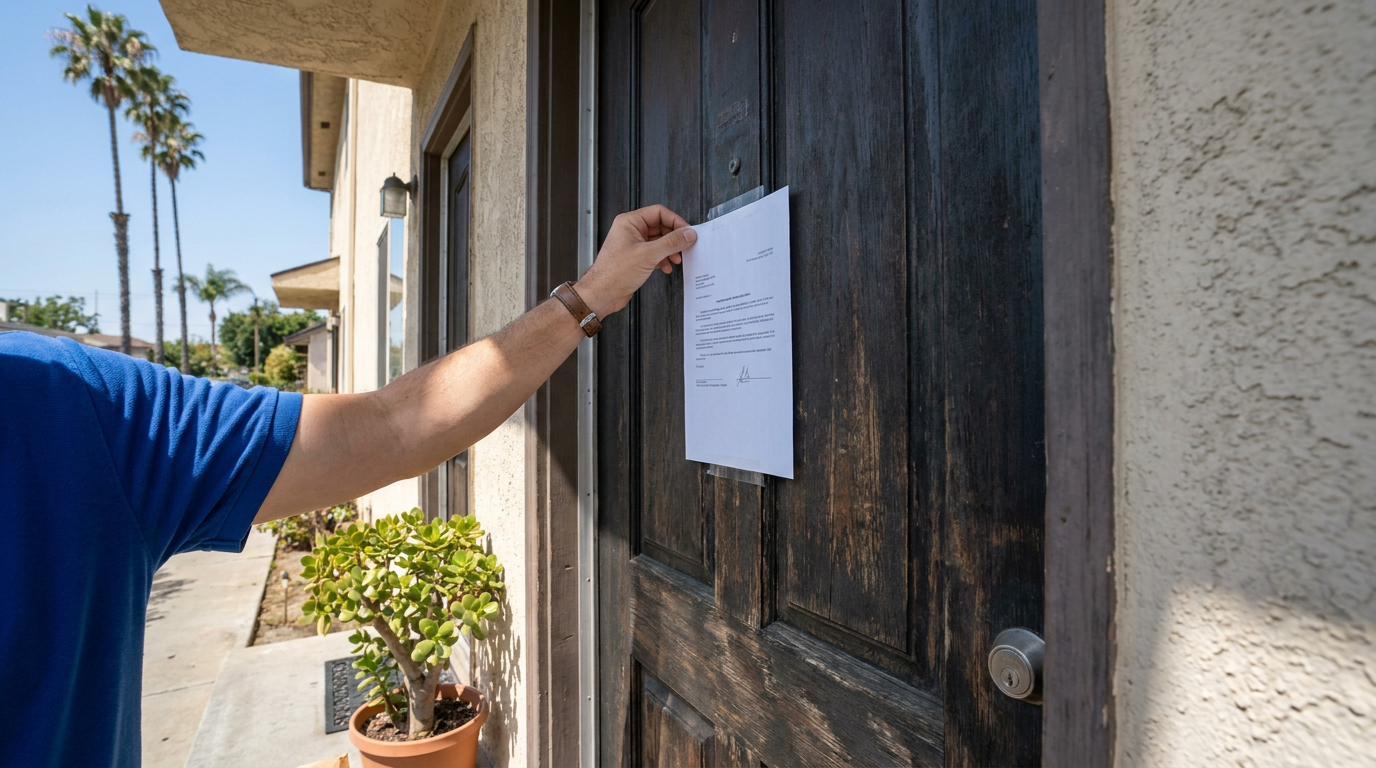
- Posting and Mailing ('Nail and Mail'): If neither personal nor substituted service can be achieved after diligent effort, affixing a copy in a conspicuous place on the property (such as the front door) and mailing a second copy via first-class mail on the same day.
After service is completed, the person who delivered the document must complete a legal Proof of Service declaration detailing the exact date, time, location, and method of delivery. This signed Proof of Service must be attached when filing the eviction complaint at the local courthouse in West Covina, Rancho Cucamonga, or Riverside.
Local Regulations and Rent Control Disclosures
Depending on where your property is situated within the San Gabriel Valley, Inland Empire, or Coachella Valley, local municipal codes or the California Tenant Protection Act of 2019 (AB 1482) may require supplemental notices. For properties subject to local rent stabilization ordinances (such as parts of Los Angeles County or specific local jurisdictions), templates may require specific statutory language informing tenants of local relocation assistance rights or specific just-cause protections. Always verify local municipal code compliance before serving documentation.
Streamline Your Property Management and Notice Compliance
Navigating delinquent accounts and legal notices requires meticulous attention to detail. Working with professional property managers protects your investment capital from costly administrative delays and legal errors. To keep your rental portfolio operating efficiently, explore our full-service property management services or talk to our team at Bright Path Property Management today.
Disclaimer: The information provided in this article is for general informational and educational purposes only and does not constitute formal legal or financial advice. California landlord-tenant laws change frequently. Consult with a qualified California real estate attorney or legal professional regarding specific eviction matters or notice requirements.